.png)
There are no items in your cart
Add More
Add More
| Item Details | Price | ||
|---|---|---|---|
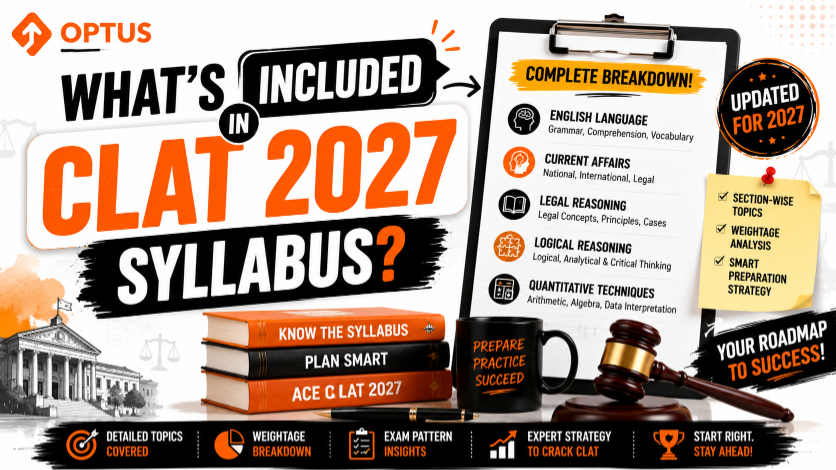
If you don’t understand the CLAT syllabus, you’re not preparing—you’re guessing. Every year, thousands of aspirants start CLAT prep by picking books. But toppers start differently. They first understand the CLAT syllabus deeply, because that’s what decides what to study, what to skip, and how to score in the 95+ percentile.
This is your complete, updated guide to the CLAT syllabus 2027, broken down in the simplest way possible.
The Common Law Admission Test (CLAT) is a national-level entrance examination for admissions to undergraduate (UG) and postgraduate (PG) law programmes offered by 27 National Law Universities in India. Understanding the CLAT syllabus is the first crucial step towards effective preparation. The exam assesses candidates on their aptitude for legal studies, English language proficiency, general knowledge, logical reasoning, and quantitative techniques.
Before diving into the detailed syllabus, it's essential to understand the CLAT exam pattern and the weightage assigned to each section.
| Section | Number of Questions | Weightage |
|---|---|---|
| English Language | 22-26 questions | ~20% |
| Current Affairs, including General Knowledge | 28-32 questions | ~25% |
| Legal Reasoning | 28-32 questions | ~25% |
| Logical Reasoning | 22-26 questions | ~20% |
| Quantitative Techniques | 10-14 questions | ~10% |
This allocation suggests that the focus should be on comprehension-heavy and reasoning-based sections, which aggregate 70% of marks.
The CLAT syllabus 2027 has five primary sections, aiming to test different skill sets in each. Each section consists of passages of 400-450 words each.
Focuses on comprehension and language skills, testing the ability to read, interpret, and analyse complex texts, as well as command of grammar and vocabulary.
| Reading Comprehension | Passages of approximately 450+ words. Questions based on: The main idea, inference and conclusion, tone and attitude, vocabulary in context, and summary. |
| Vocabulary | Synonyms and Antonyms, usage of words in sentences, fill-in-the-blanks, and cloze tests. |
| Grammar | Spotting errors, sentence correction, sentence rearrangement, and paragraph formation. |
| Preparation Tips | Read newspapers and novels, use vocabulary-building apps, practice grammar exercises, and take mock tests. |
Tests how a candidate can understand and apply legal principles in different situations.
| Principles of Law | Law of Contracts, Law of Torts, Criminal Law, Constitutional Law. |
| Application-Based Scenarios | Fact-situation questions where candidates must apply legal principles and identify the most logical solution. |
| Legal Awareness | Recent judgments, amendments, legal terms, and maxims. |
| Preparation Tips | Study basics of the Constitution and landmark judgments, practice case-based questions, and keep updated with legal developments. |
Evaluates a candidate's ability to analyse arguments and solve logical puzzles critically.
| Critical Reasoning | Identifying Arguments, Drawing Inferences, Strengthening/Weakening Arguments, Identifying Assumptions and Flaws. |
| Analytical Reasoning | Arrangements (Linear, Circular, Matrix), Puzzles, Syllogisms, Coding-Decoding, Blood Relations, Logical Sequences, Analogies, Series Completion. |
| Preparation Tips | Solve reasoning questions from competitive exam books, practice regularly, and time yourself during mock tests. |
Tests basic mathematical skills and numerical interpretation.
| Arithmetic | Percentages, Profit and Loss, Simple/Compound Interest, Time/Speed/Distance, Ratios, Averages, Number System. |
| Data Interpretation | Bar Graphs, Line Graphs, Pie Charts, Tables, Data Sufficiency. |
| Preparation Tips | Revise concepts from Class 10 Mathematics, practice for speed and accuracy, attempt data interpretation sets regularly. |
CLAT is a skill-based exam, not a memory test.
The CLAT PG question paper has 120 objective-type questions, each carrying 1 mark (0.25 penalty for incorrect answers). Like the UG pattern, this exam also has questions based on reading comprehension.
The CLAT Exam syllabus for the PG program includes:
The exam will require you to demonstrate the ability to read and comprehend issues, understand arguments, show awareness of issues addressed in the passage, identify related legal issues and facts, and summarise and apply your knowledge of law.
The CLAT Syllabus 2027 may be a comprehensive and challenging curriculum designed to test the skills and aptitude of aspiring law students. You must stay updated with the latest changes and prepare diligently to succeed in CLAT.
Key takeaways: