.png)
There are no items in your cart
Add More
Add More
| Item Details | Price | ||
|---|---|---|---|
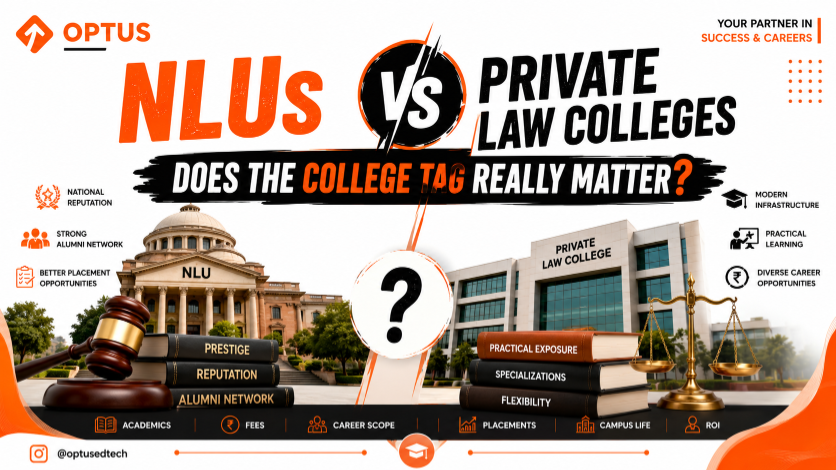
Every law aspirant reaches this question at some point during their preparation journey. After months of mock tests, current affairs revision, and long study hours, it is natural to wonder whether all this effort is truly necessary. After all, private law colleges and universities offer BA LLB programs without requiring a CLAT rank at all.
So is CLAT worth the struggle, or would a private law college get you to the same destination with far less stress? In this blog, we compare private law colleges and NLUs across the factors that actually matter—fees, faculty, placements, exposure, and long term career outcomes—so you can make an informed decision rather than a rushed one.
Before comparing them, it helps to understand what each option actually offers.
This wide range within the private category is exactly why a blanket comparison is tricky. The real comparison should be between NLUs and the private colleges most students end up considering as a backup, not the handful of elite private law schools at the very top.
| Key Factor | Details & Comparison |
|---|---|
| 1. Fees and Affordability | NLUs are public institutions, and while their fees have risen over the years, they remain significantly more affordable than most private law colleges, especially over a five-year program. Total fees at most NLUs range between 10 to 14 lakhs for the full course, whereas many private colleges, particularly the well-ranked ones, can cost anywhere between 15 to 25 lakhs or more for the same duration. For families budgeting a legal education, this difference is substantial and often decisive. |
| 2. Faculty and Academic Rigor | NLUs generally attract experienced faculty members, many with strong academic credentials and research backgrounds, since these universities were specifically established to raise the standard of legal education in India. The academic rigor, case study methods, and peer competition at NLUs tend to push students harder. Private colleges vary enormously here. Some maintain strong faculty and structured curriculums, but many rely heavily on guest faculty or practicing lawyers teaching part-time, which can affect consistency in teaching quality. |
| 3. Placements and Recruiter Access | This is often the single biggest differentiator. Top NLUs have well-established placement cells with strong relationships with national and international law firms, corporate legal departments, and litigation chambers. Recruiters actively visit NLU campuses during placement season, specifically because of the brand value these universities carry. Private law colleges, apart from a few well-known names, often struggle to attract the same tier of recruiters. Students frequently need to rely on personal networking or apply independently for internships and jobs rather than through structured campus placements. |
| 4. Peer Network and Long Term Value | An NLU degree carries brand recognition that follows you well beyond graduation. Alumni networks from NLUs are influential across law firms, the judiciary, academia, and even policy-making circles. This network often opens doors years after graduation, not just during placements. Private colleges, unless they are among the top-ranked few, generally do not carry the same weight in professional circles, which can make lateral moves or judiciary exam preparation slightly harder without that initial brand backing. |
| 5. Competitive Exposure | Being surrounded by some of the most competitive students in the country, all of whom cleared a rigorous national entrance exam, creates an environment that pushes you to grow faster. Moot court competitions, debate societies, and research opportunities at NLUs are typically more structured and nationally recognized. |
The honest answer depends on which private college you are comparing an NLU to.
If you are comparing an NLU to one of the handful of genuinely excellent private law schools, the decision becomes more nuanced, and factors like specialization, location, and personal fit matter more.
However, if the realistic alternative is a lesser known private law college with limited placements, average faculty, and a fee structure not too different from an NLU, then yes, CLAT is absolutely worth the effort. The combination of lower cost, stronger recruiter access, and long term brand value makes an NLU degree a significantly better return on investment for most students.
The real question is not whether CLAT is hard. It is whether the outcome justifies the preparation. For the vast majority of law aspirants, it clearly does.
This is a common fear, and it is completely normal. But it is worth remembering that CLAT rewards consistent preparation far more than raw talent. Thousands of students who did not consider themselves naturally strong in reasoning or current affairs have cracked CLAT with the right structured approach, honest mock test analysis, and guided mentorship.
Private law colleges are not inherently bad, and a small number of them offer genuinely strong programs. But for most students weighing an NLU against a typical private law college, the combination of affordability, placement strength, faculty quality, and long-term brand value tilts heavily in favor of NLUs.
CLAT is undoubtedly a demanding exam, but for the outcome it offers, the struggle is worth it for the overwhelming majority of serious law aspirants. What matters most is preparing the right way, with a plan that turns effort into results.
No. A small number of private law schools, such as Jindal Global Law School and Symbiosis Law School, offer strong faculty, good placements, and solid reputations. However, most private colleges do not match the placement strength or brand value of NLUs.
In most cases, yes. NLU fees for the full five year program typically range between 10 to 14 lakhs, while many private colleges charge significantly more for a similar duration.
Some do, especially the well-ranked ones, but the majority of private law colleges do not have the same recruiter access or structured placement cells that most NLUs maintain.
Most successful candidates prepare for 10 to 18 months with a structured, consistent study plan. Preparation quality matters far more than the total number of hours spent studying.
This is common, and it does not mean you should give up on NLUs. Many successful candidates improve significantly in their second attempt with better strategy and mentorship. Structured coaching like Optus EdTech can help identify and fix specific gaps rather than repeating the same preparation approach.
This depends on your priorities. If placement strength and brand value from the CLAT Consortium matter more to you, newer NLUs are often still a stronger long-term choice than most private colleges, even if some private options may offer more established campus infrastructure in the short term.