.png)
There are no items in your cart
Add More
Add More
| Item Details | Price | ||
|---|---|---|---|
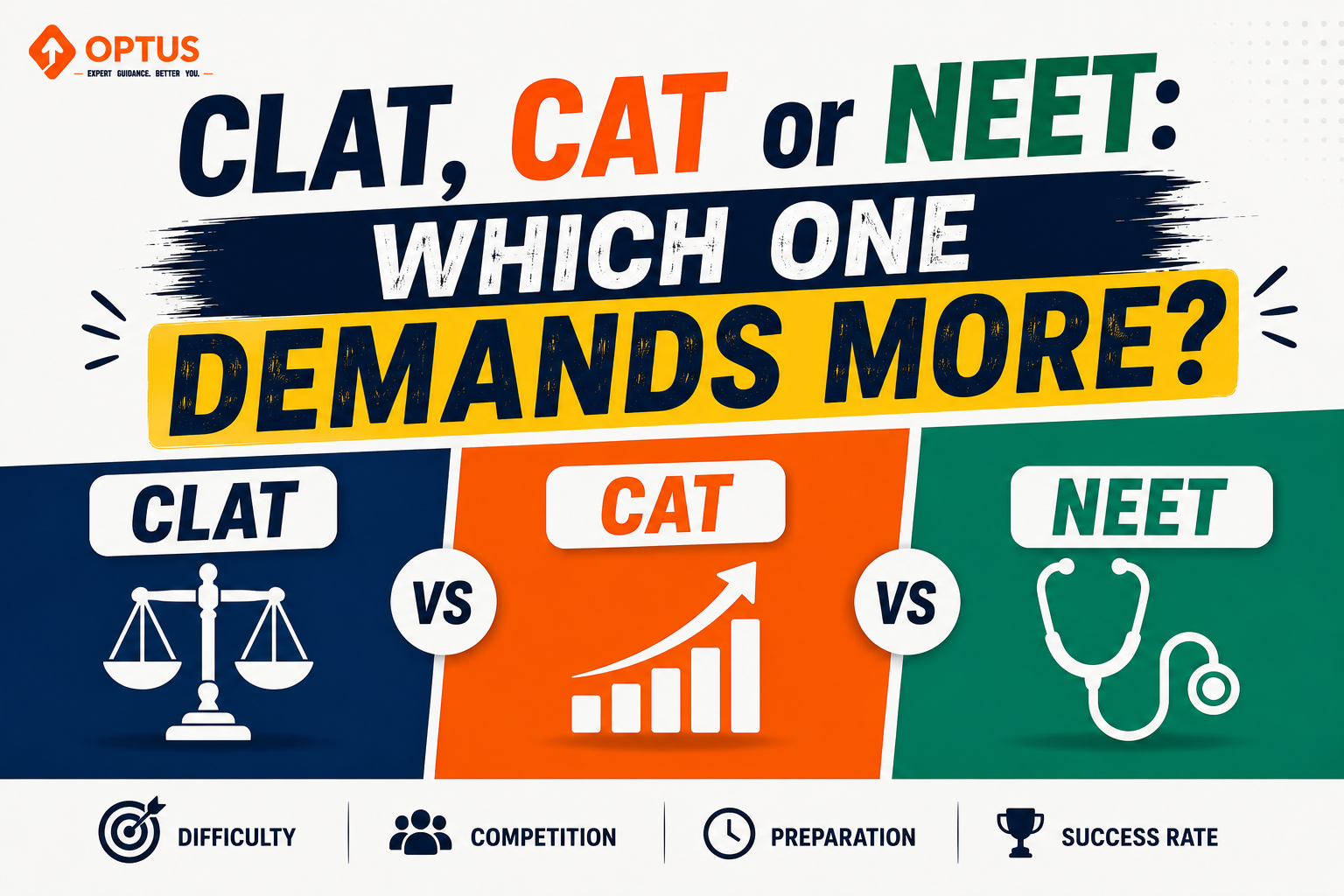
Annually, millions of anxious yet fiercely ambitious students march into examination centers across the country, each holding onto the dream of fundamentally altering their life's trajectory. These aspirations are wildly diverse: some are hunting for a prestigious managerial seat at an Indian Institute of Management (IIM) via the CAT, others are enduring the grueling path to medical school through NEET, and a rapidly expanding demographic is striving for legal excellence at a National Law University (NLU) by conquering the CLAT. This massive convergence of ambition inevitably sparks endless debates in classrooms, coaching hubs, and family living rooms: among these three academic titans, which is genuinely the most difficult to crack?
The most authentic answer is that "difficulty" is highly subjective and depends entirely on the specific cognitive and psychological demands you are evaluating. CAT is a brutal crucible of rapid decision-making and mathematical speed. NEET is a staggering marathon measuring a student's capacity to absorb, retain, and perfectly recall colossal volumes of scientific data. Meanwhile, CLAT evaluates intense reading endurance, logical dexterity, and the discipline required to maintain an unbroken awareness of global affairs. This comprehensive guide will place these three mammoth examinations side-by-side, offering a clear, objective perspective on where CLAT stands in the grand hierarchy, and explaining why attempting to rank them on a single, linear scale is inherently flawed.
High school students in their pivotal 11th and 12th grades—along with their deeply invested parents—habitually utilize established benchmarks to gauge new challenges. Because CAT and NEET have reigned as household names in India's competitive testing arena for decades, they serve as the ultimate measuring sticks. For a teenager agonizing over whether to pursue medicine, corporate management, or corporate law, mapping the relative exertion required for CLAT against the notorious rigor of NEET provides a highly necessary reality check.
This comparative analysis is also fundamentally crucial for academic stream selection. A science-track student contemplating a pivot toward jurisprudence rather than tackling NEET, or a commerce undergraduate debating whether to delay their entrance exams for a post-grad CAT attempt instead of diving straight into CLAT, desperately requires a structural, honest breakdown free from exaggerated hearsay.
The Common Law Admission Test operates as the golden ticket to over twenty premier National Law Universities nationwide. It is an intense, two-hour intellectual sprint constructed almost exclusively around advanced reading comprehension. Every single segment—whether evaluating English proficiency, General Knowledge, Legal Aptitude, Logical Reasoning, or even Quantitative Techniques—is presented in a dense, paragraph-based format. Candidates are required to swiftly read, interpret, and extract answers from these texts. The scope for blind memorization is virtually non-existent. Success hinges entirely on critical evaluation and processing speed.
The Common Admission Test is the highly revered gateway to the IIMs and elite B-schools. Its architecture evaluates Verbal Ability & Reading Comprehension, Data Interpretation & Logical Reasoning, and Quantitative Ability. CAT has earned a terrifying reputation for its draconian time constraints. Candidates are frequently forced to make split-second executive decisions regarding which complex puzzles to attack and which to ruthlessly abandon, as realistically, even top-percentile prodigies cannot complete the entire paper within the allotted time.
The National Eligibility cum Entrance Test stands as the monolithic barrier to securing an MBBS seat in India, thoroughly testing Physics, Chemistry, and Biology. In stark contrast to the aptitude-heavy nature of CLAT or CAT, NEET is incredibly reliant on massive content retention sourced directly from the NCERT syllabus. Triumph in NEET is a direct reflection of how meticulously a candidate has memorized, revised, and internalized three grueling years' worth of dense scientific theory and complex biological terminology.
To truly understand the nuances, we must break down the difficulty into distinct operational categories:
| Evaluative Metric | CLAT (Law) | CAT (Management) | NEET (Medical) |
|---|---|---|---|
| Syllabus Breadth & Depth | Defined structural framework but shallow theoretical depth. Focuses on applying logic to novel scenarios rather than reciting the Constitution. | Lacks a strictly defined syllabus. Heavily reliant on abstract aptitude, organic numerical fluency, and years of cultivated logic. | Highest Volume. Encompasses the absolute entirety of 11th and 12th-grade sciences. Omitting a single chapter can be catastrophic. |
| Time Pressure & Pacing | Allows flexibility to navigate between sections. The primary pressure is ocular fatigue and reading speed (120 questions in 120 minutes). | Most Punishing. Enforces rigid, non-transferable sectional time limits. Lingering on a question is fatal to your percentile. | Averages roughly one minute per question, which becomes highly stressful when executing complex Physics/Chemistry calculations. |
| Applicant Pool vs. Seat Ratio | Approximately 60,000 to 70,000 candidates battling for around 3,000 NLU seats. Elite tier competition remains exceptionally concentrated. | 2 to 3 lakh aspirants fighting for a highly restricted number of premium IIM seats. | Most Competitive by Volume. Excess of 20 lakh applicants competing for incredibly scarce government medical seats. |
| Preparation Methodology | A hybrid approach demanding months of consistent newspaper reading combined with aggressive, strategy-focused mock test simulations. | A highly intense, compressed sprint (typically 6-12 months post-grad) focused strictly on tactical question selection and raw speed. | Longest Duration. A grueling two-year marathon of endless content mastery and repetitive memorization cycles. |
| Negative Marking Risks | Penalizes incorrect answers by a quarter (0.25) mark. Risk management is essential but slightly more forgiving. | Variable. Usually deducts one mark for MCQs, but non-MCQ (TITA) questions carry zero penalty. | Most Severe. Strips a full mark for every error out of a 4-mark potential, heavily punishing reckless guesswork. |
If your definition of difficulty is tethered to the sheer, overwhelming volume of scientific theory and data that must be flawlessly memorized, then NEET is unequivocally the most brutal undertaking.
If you consider difficulty to be the psychological torture of racing against a merciless, rigidly segmented clock while executing complex mathematical algorithms, CAT comfortably claims the crown.
However, if difficulty signifies the mental discipline needed to process towering walls of dense text, maintain an unbroken daily ritual of global news consumption, and deploy objective logic to entirely alien scenarios rather than relying on familiar facts, CLAT presents a uniquely exhausting challenge of its own.
Fundamentally, none of these assessments is objectively "easier" than the other once you dissect what cognitive faculties they are actively measuring. A highly successful NEET candidate boasting a photographic memory might initially flounder under CLAT's demand for rapid, interpretive reasoning. Conversely, a brilliant CLAT prospect would likely be crushed by the sheer volume of NEET's organic chemistry without years of dedicated study. These exams merely reward entirely different intellectual strengths.
If you are a high school student currently standing at the precipice of choosing between medicine, management, or law, your decision must absolutely not be driven by perceived difficulty alone. The far superior question to ask yourself is: Which daily grind do I actually find stimulating?
If dissecting dense editorials, debating socio-political nuances, and formulating logical arguments excites you, CLAT preparation will feel significantly more organic than endlessly diagramming cellular structures for NEET. If you possess a natural affinity for raw data, percentages, and thrive in high-pressure, time-bound environments, delaying for a post-graduate CAT attempt might be your ultimate calling.
It is also critical to acknowledge a unique psychological pressure associated with CLAT: unlike CAT, which is attempted by mature graduates, CLAT forces seventeen and eighteen-year-olds to execute a massive, high-stakes career maneuver at a very early stage in their lives.
| Is CLAT a simpler alternative to NEET? |
| Labeling one as simpler is a false equivalence. NEET requires memorizing an ocean of scientific data, whereas CLAT operates on linguistic agility, critical deduction, and real-world awareness. Students who excel at reading but struggle with rote science will naturally find CLAT more accommodating. |
| How does the toughness of CLAT compare to CAT? |
| Their difficulties manifest differently. CAT is notorious for inducing panic through severe sectional time constraints and complex math. CLAT is more flexible with time allocation but physically exhausts candidates with massive, dense reading passages. |
| Which examination boasts the most terrifying competition level? |
| By pure numerical volume, NEET dwarfs the others with over 20 lakh applicants fighting for scarce medical seats. However, cracking the absolute top-tier institutions (like IIM Ahmedabad or NLSIU Bangalore) remains fiercely competitive across all three domains. |
| Is CLAT a viable option for someone who struggles heavily with mathematics? |
| Absolutely. The Quantitative Techniques section in CLAT carries the lowest overall weightage and focuses entirely on foundational 10th-grade arithmetic and basic data interpretation, making it vastly more approachable than the advanced mathematics tested in CAT. |