.png)
There are no items in your cart
Add More
Add More
| Item Details | Price | ||
|---|---|---|---|

If you are preparing for CAT Quantitative Aptitude, CAT Simple and Compound Interest Questions are one of the most scoring areas in Arithmetic. These questions are usually based on interest, amount, principal, time, population growth, depreciation, installments and percentage change.
CAT Exam may not always ask direct formula-based questions, but the concepts of Simple Interest and Compound Interest are often tested through application-based problems. In this blog, you will learn formulas, tricks, examples and practice questions to strengthen this topic.
CAT Simple and Compound Interest Questions test your understanding of money, time and rate of interest. The basic idea is simple: the value of money changes with time. A rupee today is not equal to a rupee tomorrow.
When money is borrowed or invested, an extra amount is paid or received over time. This extra amount is called interest. CAT exam pattern uses this concept in questions related to loans, bank deposits, investments, depreciation and population change.
Simple and Compound Interest Questions for CAT are important because they are closely connected with Percentages, Profit and Loss, Ratio, Growth and Decay. A strong hold on this topic can help you solve many Arithmetic-based questions faster.
| Area | CAT Relevance |
|---|---|
| Simple Interest | Basic arithmetic and direct calculation |
| Compound Interest | Growth-based and application questions |
| Installments | Loan and repayment-based questions |
| Population Growth | Compound growth application |
| Depreciation | Compound decrease application |
Before solving CAT Simple and Compound Interest Questions, it is important to understand the basic difference between SI and CI.
| Simple Interest | Compound Interest |
|---|---|
| Calculated only on the principal amount | Calculated on principal plus previous interest |
| Interest remains the same every year | Interest increases every year |
| Formula is easier | Formula involves powers |
| Used for basic loan questions | Used for growth, decay and investment questions |
SI = (P × R × T) / 100
Here, P is Principal, R is Rate of Interest and T is Time.
Amount = Principal + Simple Interest
Amount = P(1 + R/100)n
Amount = P(1 + R/200)2n
Amount = P(1 + R/400)4n
Amount = P(1 + R1/100)(1 + R2/100)(1 + R3/100)
Present Worth = Future Value / (1 + R/100)n
R = 100[(x)1/n - 1]
R = [(A2 - A1) / A1] × 100
Installment questions are based on loans. If a person borrows money from a bank and agrees to repay it in equal yearly installments, the present value of all installments must be equal to the loan amount.
These questions are important for advanced CAT Arithmetic questions for practice because they combine Compound Interest, Present Value and logical calculation.
Example:
A person takes a loan of ₹10,000 at 10% compound interest and repays it in 2 equal yearly installments. Find the installment.
Solution:
Let each installment be X.
10000 = X/(1.1) + X/(1.1)2
By solving this equation, we can find the value of X.
Population growth questions follow the same formula as Compound Interest. The only difference is that the rate of population growth replaces the rate of interest.
Q1. Find the simple interest on ₹5000 at 10% per annum for 2 years.
A. ₹500 | B. ₹800 | C. ₹1000 | D. ₹1200
Answer: C. ₹1000
Q2. A sum of ₹8000 is invested at 5% simple interest for 3 years. Find the interest.
A. ₹1000 | B. ₹1200 | C. ₹1400 | D. ₹1600
Answer: B. ₹1200
Q3. A sum becomes ₹6000 in 2 years at 10% simple interest. Find the principal.
A. ₹4000 | B. ₹4500 | C. ₹5000 | D. ₹5500
Answer: C. ₹5000
Q4. Find the compound amount on ₹10000 at 10% per annum for 2 years.
A. ₹11000 | B. ₹12000 | C. ₹12100 | D. ₹12500
Answer: C. ₹12100
Q5. The compound interest on ₹5000 at 10% per annum for 2 years is:
A. ₹1000 | B. ₹1050 | C. ₹1100 | D. ₹1150
Answer: B. ₹1050
Q6. A sum doubles itself in 5 years at simple interest. In how many years will it become 4 times?
A. 10 years | B. 12 years | C. 15 years | D. 20 years
Answer: C. 15 years
Q7. A sum becomes ₹12100 in 2 years at 10% compound interest. Find the principal.
A. ₹9000 | B. ₹9500 | C. ₹10000 | D. ₹10500
Answer: C. ₹10000
Q8. A machine depreciates by 10% every year. If its present value is ₹50000, what will be its value after 2 years?
A. ₹40000 | B. ₹40500 | C. ₹41000 | D. ₹42000
Answer: B. ₹40500
Q9. The population of a town increases by 20% every year. If the current population is 10000, what will be the population after 2 years?
A. 12000 | B. 13000 | C. 14000 | D. 14400
Answer: D. 14400
Q10. At compound interest, a sum becomes ₹11000 after 1 year and ₹12100 after 2 years. Find the rate of interest.
A. 8% | B. 9% | C. 10% | D. 12%
Answer: C. 10%
Q11. A sum of ₹8,000 is invested at 10% compound interest per annum. What will be the amount after 3 years?
A. ₹10,120 | B. ₹10,648 | C. ₹10,920 | D. ₹11,000
Answer: B. ₹10,648
Q12. At what rate of simple interest will ₹5,000 become ₹6,500 in 3 years?
A. 8% | B. 9% | C. 10% | D. 12%
Answer: C. 10%
Q13. The compound interest on ₹20,000 for 2 years at 5% per annum is:
A. ₹2,000 | B. ₹2,025 | C. ₹2,050 | D. ₹2,100
Answer: C. ₹2,050
Q14. A sum amounts to ₹24,200 after 2 years at 10% compound interest. Find the principal.
A. ₹18,000 | B. ₹19,000 | C. ₹20,000 | D. ₹22,000
Answer: C. ₹20,000
Q15. What is the simple interest on ₹12,000 at 15% per annum for 4 years?
A. ₹6,000 | B. ₹6,800 | C. ₹7,000 | D. ₹7,200
Answer: D. ₹7,200
Q16. A machine depreciates by 20% every year. Its present value is ₹50,000. What will be its value after 2 years?
A. ₹30,000 | B. ₹31,000 | C. ₹32,000 | D. ₹33,000
Answer: C. ₹32,000
Q17. A population increases by 5% every year. If the current population is 40,000, what will it be after 2 years?
A. 43,500 | B. 44,000 | C. 44,100 | D. 45,000
Answer: C. 44,100
Q18. Find the compound interest on ₹16,000 at 25% per annum for 2 years.
A. ₹8,500 | B. ₹9,000 | C. ₹9,500 | D. ₹10,000
Answer: B. ₹9,000
Q19. A sum becomes ₹8,820 in 2 years at 5% compound interest. Find the principal.
A. ₹7,800 | B. ₹8,000 | C. ₹8,200 | D. ₹8,500
Answer: B. ₹8,000
Q20. The difference between Compound Interest and Simple Interest on ₹10,000 for 2 years at 10% is:
A. ₹50 | B. ₹100 | C. ₹150 | D. ₹200
Answer: B. ₹100
Q21. A sum doubles itself in 8 years at compound interest. In how many years will it become four times?
A. 12 years | B. 14 years | C. 16 years | D. 18 years
Answer: C. 16 years
Q22. What principal will amount to ₹13,310 in 3 years at 10% compound interest?
A. ₹9,000 | B. ₹10,000 | C. ₹11,000 | D. ₹12,000
Answer: B. ₹10,000
Q23. Find the simple interest on ₹7,500 at 12% for 5 years.
A. ₹4,000 | B. ₹4,200 | C. ₹4,500 | D. ₹4,800
Answer: C. ₹4,500
Q24. A sum becomes ₹15,625 in 4 years at 25% compound interest. Find the principal.
A. ₹6,000 | B. ₹6,400 | C. ₹6,800 | D. ₹7,000
Answer: B. ₹6,400
Q25. If ₹15,000 earns ₹3,600 as simple interest in 3 years, what is the annual rate?
A. 6% | B. 7% | C. 8% | D. 9%
Answer: C. 8%
Q26. At compound interest, ₹12,000 becomes ₹13,230 in one year. Find the rate of interest.
A. 8% | B. 9% | C. 10% | D. 10.25%
Answer: D. 10.25%
Q27. A laptop loses 15% of its value every year. If its current price is ₹80,000, what will be its value after one year?
A. ₹66,000 | B. ₹67,000 | C. ₹68,000 | D. ₹68,500
Answer: C. ₹68,000
Q28. A sum invested at simple interest becomes ₹18,000 after 4 years. The principal was ₹15,000. Find the rate.
A. 4% | B. 5% | C. 6% | D. 7%
Answer: B. 5%
Q29. Find the amount if ₹25,000 is invested for 2 years at 8% compound interest.
A. ₹28,800 | B. ₹29,000 | C. ₹29,160 | D. ₹29,500
Answer: C. ₹29,160
Q30. A bank compounds interest half-yearly at 12% per annum. The amount on ₹10,000 after one year will be:
A. ₹11,200 | B. ₹11,236 | C. ₹11,250 | D. ₹11,300
Answer: B. ₹11,236
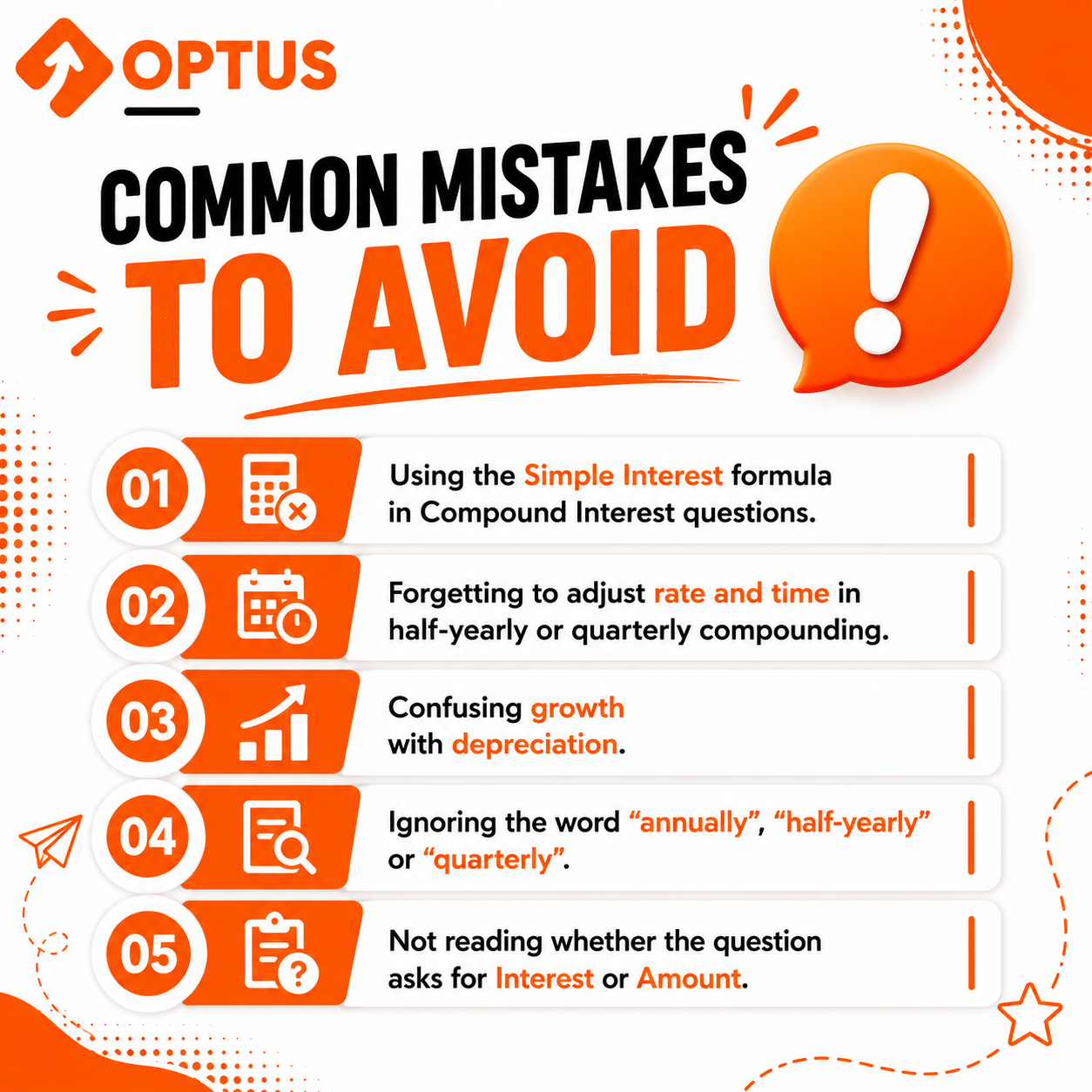
In CAT syllabus the Simple and Compound Interest Questions are important for building a strong base in Arithmetic. These questions may look formula-based, but CAT often tests them through practical situations like population growth, depreciation, installments and investments.
To master this topic, understand the concepts, revise formulas, solve different question types and practice regularly from mocks and a CAT compound interest questions PDF. With the right approach, Simple and Compound Interest Questions for CAT can become one of your most scoring areas in Quant.