.png)
There are no items in your cart
Add More
Add More
| Item Details | Price | ||
|---|---|---|---|
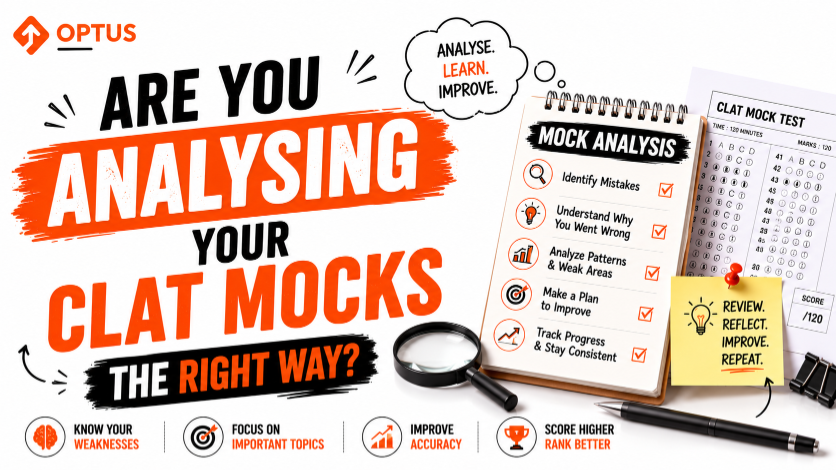
If you're currently preparing for the highly competitive CLAT, you have likely heard this standard piece of advice countless times from mentors and peers alike: "Take more mock tests." However, here is the fundamental truth that top rankers intimately understand and average aspirants completely overlook—taking mocks alone will never improve your score. Analysing them properly will.
In fact, the primary differentiator between an average CLAT candidate and a top ranker is not the absolute number of mock tests they attempt, but the rigorous manner in which they break down and evaluate each test afterward. Consider two students attempting the exact same mock test under identical conditions. The first student merely checks their final score, experiences a fleeting emotional wave of happiness or disappointment, and immediately shifts focus to scheduling the next mock. The second student, however, systematically invests two to three hours unearthing the mechanics behind every mistake, every lucky guess, every skipped question, and every subtle time-management bottleneck. A few months down the line, the discrepancy in their performance speaks for itself.
If you have ever found yourself wondering how to break past score plateaus and analyze CLAT mocks exactly like a top ranker, this step-by-step framework will map out the complete diagnostic process.
Attempting a mock test simply tells you where your performance stands today. Analyzing that mock test tells you exactly how to optimize your score tomorrow. Every single mock you complete serves as a dense reservoir of data, cleanly revealing:
Completely ignoring the deep analysis phase of your mock routine is structurally identical to undergoing an expensive, comprehensive medical test but refusing to read the laboratory report.
| Simply Attempting Mocks | Proper Mock Analysis |
|---|---|
| Yields only a static, isolated score. | Delivers a dynamic, actionable improvement plan. |
| Displays your current rank among peers. | Explains precisely why your rank fluctuated. |
| Provides temporary, volatile confidence shifts. | Fosters long-term, structural score improvement. |
| Focuses strictly on maximizing raw marks. | Focuses on diagnosing underlying mistakes. |
| Fails to cultivate an agile exam strategy. | Builds solid, unshakeable exam temperament. |
The first rule of elite mock evaluation is counter-intuitive: do not rush to open the answer key the second the timer stops. Step away from your desk and take a short, deliberate break of fifteen to twenty minutes. Refresh yourself, step away from the screen, and return to your workspace with a perfectly neutral, calm state of mind. Emotional reactions heavily distort objective analysis; whether you suspect your performance was stellar or disastrous, evaluating the data with a clear head prevents knee-jerk adjustments.
Before you glance at the solution sheet, document your internal raw observations. Force yourself to answer explicit behavioral questions:
Comparing your real-time exam feelings with the hard empirical performance data is a core habit of top scorers, many of whom keep a dedicated notebook explicitly for these raw reflections.
A fatal mistake made during self-evaluation is only reviewing the red flags—the incorrect responses. To truly refine your execution, you must rigorously categorize and evaluate every distinct type of prompt:
High scorers treat errors as precise data points. Instead of vaguely note-taking a question as "wrong," you must utilize a structured Mistake Tracker to identify absolute trends over a multi-mock timeline.
| Mistake Type | Diagnostic Definition | Actionable Solution |
|---|---|---|
| Conceptual Error | Completely misunderstood the foundational legal principle or logical core. | Return to core theory notes; rebuild the concept from scratch. |
| Reading Error | Misread the baseline text, overlooked key qualifiers, or missed constraints. | Practice active reading; underline key structural qualifiers. |
| Silly Mistake | Possessed the right answer mentally but mis-marked the final option box. | Slow down final execution; double-verify choices before clicking. |
| Time Pressure Error | Forced to abandon highly doable problems at the tail end of the test. | Optimize section-wise time boundaries; skip bottlenecks faster. |
| Guessing / Ego Error | Gambled on an option without clear, structured process-of-elimination work. | Enforce a strict rule: no elimination, no attempt. |
After compiling data across fifteen to twenty distinct mocks, the mathematical distribution of your errors will become completely clear (e.g., discovering forty percent of errors stem from Current Affairs gaps, while thirty percent are simple speed-induced reading errors). Once the precise operational pattern is visible, target tracking becomes simple.
Move past focusing purely on isolated vocabulary drills. Instead, evaluate the core mechanics of your passage execution: Did you genuinely map the passage architecture, or did your reading speed collapse under dense arguments? If comprehension latency is draining your time, prioritize daily structured reading exposure over passive grammar flashcards.
Isolate the exact nature of your informational errors: Did the question cover a topic you completely missed in your baseline scope, or did you possess the knowledge but suffer a retrieval failure due to incomplete revision? Build a dynamic, centralized revision ledger explicitly for topics that routinely slip through the cracks during testing.
Legal reasoning errors rarely stem from a lack of general knowledge; they happen because students apply external emotional judgments instead of sticking strictly to the explicit text of the principle, or they entirely miss key operational exceptions. Always perform a forensic comparison between your internal reasoning path and the official key explanation.
Track your precise points of confusion: Are you consistently misidentifying underlying arguments, overthinking straightforward passages, or failing to distinguish between two close options? Logical consistency scales up dramatically the moment you carefully review option elimination logic.
Differentiate clearly between raw calculation slips, misread data sets, or structural formula gaps. Elite test-takers treat math sets with a business mindset: if a particular data set requires lengthy, winding calculations, they skip it instantly and return only if the final clock permits.
Many students celebrate high raw attempt counts without factoring in precision. Scoring eighty-eight marks on a highly precise, low-waste track of one hundred and two attempts demonstrates vastly superior long-term potential compared to scraping ninety marks out of an erratic, error-riddled run of one hundred and eighteen attempts. Consistent accuracy scaling is significantly more valuable than reckless attempt maximization.
The Gold Standard Rule: Re-attempt every single missed question independently without looking at the answer key. If you secure the correct solution on the second clean pass, the error was induced by exam anxiety or focus drop. If you fail again, the issue is structural and requires immediate conceptual revision.
To keep your diagnostic routine sharp and structured, build your post-mock timeline around this precise allocation model:
Your CLAT score never actually improves while you are running the mock clock—it improves during the quiet, deliberate hours you spend breaking down your mistakes afterward. Stop treating mock tests as a check-the-box weekly ritual, and start treating each attempt as a profound diagnostic masterclass. Focus heavily on reducing repeated errors, tightening accuracy metrics, and protecting your time allocation. Execute this level of thoughtful review consistently, and the final percentile on exam day will take care of itself.